Click here to view
Showing posts with label Space News. Show all posts
Saturday, March 15, 2008
Earth and Moon as seen from Mars
Breathtaking view of our Earth and Moon from Planet Mars. No wonder aliens visit once in a while
. Click on the link below to view full resolution. Source - NASA

Click here to view
Click here to view
Friday, March 14, 2008
Lunar Eclipse - Feb 20, 2008
Check out this video.. I know its late but its worth watching 
Tuesday, March 4, 2008
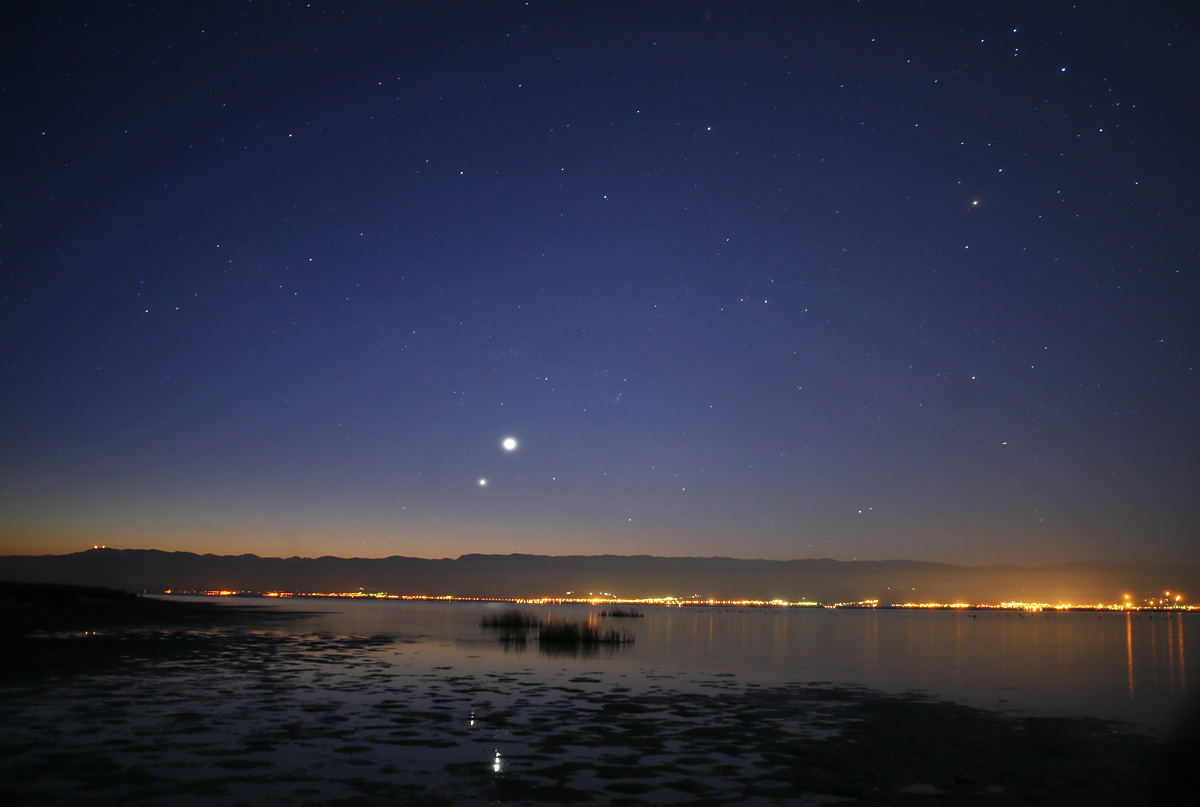
Venus and Jupiter in the Morning Skies
These two celestial bodies shining brightly in the east before sunrise are actually children of the Sun, the planets Venus and Jupiter. The second and third brightest objects in the sky at Night after the Moon. Venus and Jupiter appeared separated by about 2 degrees when this picture was taken on January 30th. Source - NASA
Click on the link below to see Venus and Jupiter in the Morning Skies.

Click here to view full resolution
Click on the link below to see Venus and Jupiter in the Morning Skies.
Click here to view full resolution
Tuesday, February 5, 2008
Planet Earth at night
The Optical Spectroscopic and Infrared Remote Imaging System (OSIRIS) camera on board the Rosetta spacecraft observed Earth. A sun-illuminated crescent can be seen around Antarctica in this image that is a colour composite combining images obtained at various wavelengths. 

Click here to view full resolution
Saturday, February 2, 2008
Wo(man) on Mars?
What is it? A man, a woman or is it just a rock?? 

A NASA photo taken on mars by spirit rover. The shape resembles a man kneeling down with his right arm outstretched.
Monday, January 21, 2008
Falling Meteor - Caught on Tape
The meteor was moving north over the Rocky Mountains from the U.S. Southwest to Canada on August 10,1972 and was filmed by a tourist at the Grand Teton National Park in Wyoming with an 8-millimeter color movie camera.
This meteor was supposed to have ended its life in a Hiroshima-atomic bomb like blast,
but it never hit the ground. It continued to fly 58km above the ground and grazed Earth's atmosphere for about 100 seconds, before skipping out and going back into its orbit around the sun.
Click here if you can't view the video.
This meteor was supposed to have ended its life in a Hiroshima-atomic bomb like blast,
Click here if you can't view the video.
Thursday, January 10, 2008
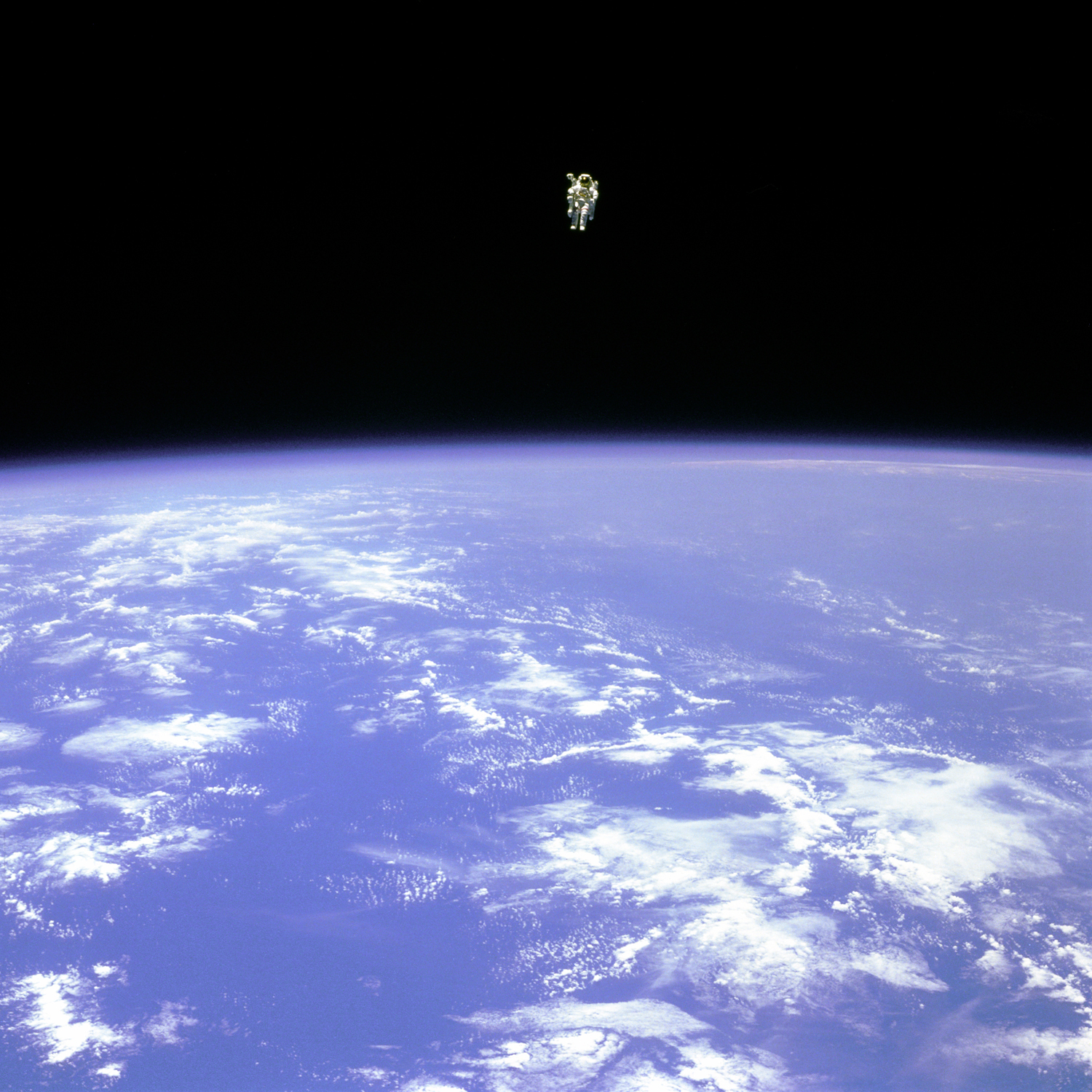
Picture of an astronaut walking in space.
Have you seen an astronaut walking in space? Well, its not something you see everyday down the street. Take a look at it. At about 100 meters from the cargo bay of the space shuttle Challenger, Bruce McCandless II was further out than anyone had ever been before.
Just in case you are still wondering what you are looking at.. The Blue color is our Earth and the white little spot is the astronaut.

Click here to see a full resolution image
Just in case you are still wondering what you are looking at.. The Blue color is our Earth and the white little spot is the astronaut.
Click here to see a full resolution image
Tuesday, January 1, 2008
Huge Asteroid Headed for Earth
SCIENTISTS have identified an asteroid that has a faint chance of ploughing into the Earth, leaving a two-kilometre-wide crater and wiping out life for 6000 square kilometres.The asteroid measures 130 metres across and is travelling at 70,000 km/h. It would cause huge devastation if it hit the planet.Called 2007 VK184, the space rock is 90 million kilometres from Earth and could hit in 2048. It has earned a rare hazard rating of "one" on the Torino scale, the international barometer of space object impact risk.But while asteroid experts last week warned of the tremendous damage such a collision would cause, they were hopeful the risk of impact would diminish as more was discovered about VK184's path."The chances are that the probability (of an impact) will come back down to close to zero," said astronomer Gordon Garradd, who has identified numerous asteroids and works at the Siding Springs telescope in Coonabarabran, 450 kilometres north-west of Sydney.He said VK184 had been observed for only 35 days and, given its distance from Earth and the long time until a possible impact, more readings were necessary to determine if a collision was a possibility.NASA's Near Earth Object Program website says VK184 is travelling at 19 kilometres a second. It has a 1-in-3030 chance of hitting the planet in 2048.The object's Torino scale rating of one (out of a possible 10) signifies it has a tiny chance of collision with Earth and that there is no cause for public concern. Every other known object that will approach Earth this century has a zero rating.If the object struck Earth it would be up to three times worse than the asteroid that hit Russia in 1908.
Saturday, December 29, 2007
Earth-Asteroid Collision Formed Moon Later Than Thought
The moon was formed from fragments of Earth after a collision with a giant asteroid relatively late in our planet's formation, new tests of moon rocks show.
The finding upends many of the prior theories for how the moon came to be, researchers say.
Scientists have long believed that the moon was formed by a collision between our planet and a Mars-size object.
Computer models have shown that in this scenario 80 percent of the moon's material should have come from the asteroid, with only 20 percent from Earth.
But the new study of moon rocks collected three decades ago by Apollo astronauts, however, found that Earth and the rocks were too similar for that to be the case.
Earthly Material
The most likely explanation is that the moon was formed primarily of Earthly material, the authors say.
Lead author Mathieu Touboul of the Swiss Federal Institute of Technology in Zurich said there is another theory that may explain its formation.
"Alternatively, the material from which the moon eventually formed was a magma disk, connected to the Earth by a common atmosphere," he said in a statement.
Material from Earth and the nascent moon could then be exchanged via a shared metal-vapor atmosphere.
By the time the two worlds had settled back down and begun drifting apart, their compositions would have been virtually identical.
"New simulations of such a process have recently shown that such exchange is possible," Touboul said.
The study will appear tomorrow in the journal Nature.
Young Moon
The study also found that the moon is younger than previously believed.
Prior studies had found that it formed when Earth was about 30 million years old. But now it appears that the impact occurred 30 million years after that.
"And it could have [been] as late as 140 million years after the solar system began to condense," said Alan Brandon of NASA Johnson Space Center in Houston, Texas.
Brandon's commentary on the new study also appears in tomorrow's Nature.
Elemental "Clock"
The key to the new study was a new method for looking at trace isotopes in moon rocks, particularly of the element tungsten-182.
Tungsten-182 is formed by the radioactive decay of halfnium-182, which has a half-life of nine million years.
By comparing the abundance of tungsten-182 to that of another isotope, tungsten-184—which is not formed from halfnium—it's possible to determine how old rocks were when the magma that formed them solidified.
"This nice thing is that, [geologically speaking], this radio-isotopic clock is very short-lived," Brandon said. That makes it extremely useful for dating events early in the life of the solar system.
This "clock," though well-known, had been difficult to use for the moon. That's because the rocks collected by Apollo astronauts had been sitting on the lunar surface for billions of years.
"During that whole time, they've been bombarded with cosmic rays," Brandon said. "Cosmic rays will hit an atom and change it.
"If you don't correct for that you get the wrong radiometric [date] on your clock," Brandon said.
The new study gets around the problem by using tiny fragments of metal contained in the rocks.
Long-lived Magma
Yet another surprise was that the moon's early ocean doesn't appear to have solidified until about 120 million years after the beginning of the solar system. (Explore an interactive solar system.)
That's 60 million years after the most likely date for the creation of the moon.
"That means that the moon stayed molten for quite a while," Brandon said.
He noted that computer models had suggested the magma should solidify much more quickly.
Brandon was involved in another study published in Nature earlier this year on Martian meteorites that suggested the red planet had magma oceans that were also slow to solidify.
Scientists aren't sure if the same thing happened on Earth, Brandon said.
However, "We're seeing magma oceans that last a lot longer [than previously believed] on all planets, and it bodes interesting things for Earth." This content is written by Richard A. Lovett
The finding upends many of the prior theories for how the moon came to be, researchers say.
Scientists have long believed that the moon was formed by a collision between our planet and a Mars-size object.
Computer models have shown that in this scenario 80 percent of the moon's material should have come from the asteroid, with only 20 percent from Earth.
But the new study of moon rocks collected three decades ago by Apollo astronauts, however, found that Earth and the rocks were too similar for that to be the case.
Earthly Material
The most likely explanation is that the moon was formed primarily of Earthly material, the authors say.
Lead author Mathieu Touboul of the Swiss Federal Institute of Technology in Zurich said there is another theory that may explain its formation.
"Alternatively, the material from which the moon eventually formed was a magma disk, connected to the Earth by a common atmosphere," he said in a statement.
Material from Earth and the nascent moon could then be exchanged via a shared metal-vapor atmosphere.
By the time the two worlds had settled back down and begun drifting apart, their compositions would have been virtually identical.
"New simulations of such a process have recently shown that such exchange is possible," Touboul said.
The study will appear tomorrow in the journal Nature.
Young Moon
The study also found that the moon is younger than previously believed.
Prior studies had found that it formed when Earth was about 30 million years old. But now it appears that the impact occurred 30 million years after that.
"And it could have [been] as late as 140 million years after the solar system began to condense," said Alan Brandon of NASA Johnson Space Center in Houston, Texas.
Brandon's commentary on the new study also appears in tomorrow's Nature.
Elemental "Clock"
The key to the new study was a new method for looking at trace isotopes in moon rocks, particularly of the element tungsten-182.
Tungsten-182 is formed by the radioactive decay of halfnium-182, which has a half-life of nine million years.
By comparing the abundance of tungsten-182 to that of another isotope, tungsten-184—which is not formed from halfnium—it's possible to determine how old rocks were when the magma that formed them solidified.
"This nice thing is that, [geologically speaking], this radio-isotopic clock is very short-lived," Brandon said. That makes it extremely useful for dating events early in the life of the solar system.
This "clock," though well-known, had been difficult to use for the moon. That's because the rocks collected by Apollo astronauts had been sitting on the lunar surface for billions of years.
"During that whole time, they've been bombarded with cosmic rays," Brandon said. "Cosmic rays will hit an atom and change it.
"If you don't correct for that you get the wrong radiometric [date] on your clock," Brandon said.
The new study gets around the problem by using tiny fragments of metal contained in the rocks.
Long-lived Magma
Yet another surprise was that the moon's early ocean doesn't appear to have solidified until about 120 million years after the beginning of the solar system. (Explore an interactive solar system.)
That's 60 million years after the most likely date for the creation of the moon.
"That means that the moon stayed molten for quite a while," Brandon said.
He noted that computer models had suggested the magma should solidify much more quickly.
Brandon was involved in another study published in Nature earlier this year on Martian meteorites that suggested the red planet had magma oceans that were also slow to solidify.
Scientists aren't sure if the same thing happened on Earth, Brandon said.
However, "We're seeing magma oceans that last a lot longer [than previously believed] on all planets, and it bodes interesting things for Earth." This content is written by Richard A. Lovett
Friday, December 28, 2007
Time Magazine: An Asteroid Hurtles Toward Mars
Astronomers have good news, better news and some bad news about an asteroid known as 2007 WD5. The good news is that this 164-ft.-wide chunk of speeding space rock, discovered in November in an ongoing search for potential threats to Earth, won't hit our planet any time in the foreseeable future. The better news — for eager space-watchers — is that the asteroid, currently about halfway between Earth and Mars, has a plausible chance of hitting the Red Planet at the end of January. If it does, astronomers will be treated to an unprecedented sight.
The event itself, however, will have plenty of precedent. The craters that pock the surface of Mars, the Moon, Mercury and other Solar System bodies come from about four billion years' worth of this sort of thing. Earth has had plenty of collisions too; it's just that erosion, continental drift and vegetation have erased or hidden most of them. Not all, though: Meteor Crater, in Arizona, was blasted out some 50,000 years ago by an asteroid about the same size as 2007 WD5. A much bigger object, a few miles across, is thought by many scientists to be the reason the dinosaurs died out some 65 million years ago.
If 2007 WD5 does smack into Mars, every telescope on Earth will be pointed in that direction — just as they were in 1994 when Comet Shoemaker-Levy 9 crashed into Jupiter. In that case, the comet broke up while it was still in orbit, so astronomers watched nearly two dozen individual impacts. But Jupiter is made mostly of thick clouds, so there was no lasting scar, and because it lies so far from Earth, the event wasn't quite as spectacular as this one promises to be. Asteroid 2007 WD5 should release some 3 megatons of energy if it slams into solid ground near Mars' equator, and orbiting satellites will show the aftermath with crystal clarity.
Finally, the bad news: 2007 WD5 has only a 1-in-75 chance of actually hitting Mars, which means astronomers would be wise to be pessimistic. But the possibility of impact calls to mind a loosely related incident that occurred almost exactly 100 years ago, when something exploded above the Tunguska region of Siberia, flattening trees in a 25-mile radius, their trunks pointing outward from the epicenter of the blast. Scientists are pretty sure it was a comet or asteroid — about the same size as 2007 WD5, as it happens — that disintegrated from its own shock wave as it plowed through the atmosphere. (UFO enthusiasts have long been convinced it was a flying saucer that somehow made it across trillions of miles of interstellar space safely, only to blow up above Russia.) The scientific explanation would account for the aerial explosion, and also the fact that no crater has been found.
Except that now maybe it has. An Italian team has measured seismic waves reflecting off a high-density spot in the bottom of the suspiciously crater-shaped Lake Cheko, which lies close to the event's ground zero. It could be a piece of the original object — and finding it could help investigators understand exactly what happened a century ago.
If they find a burned-out flying-saucer engine, all bets are off.This content is written by MICHAEL D. LEMONICK
The event itself, however, will have plenty of precedent. The craters that pock the surface of Mars, the Moon, Mercury and other Solar System bodies come from about four billion years' worth of this sort of thing. Earth has had plenty of collisions too; it's just that erosion, continental drift and vegetation have erased or hidden most of them. Not all, though: Meteor Crater, in Arizona, was blasted out some 50,000 years ago by an asteroid about the same size as 2007 WD5. A much bigger object, a few miles across, is thought by many scientists to be the reason the dinosaurs died out some 65 million years ago.
If 2007 WD5 does smack into Mars, every telescope on Earth will be pointed in that direction — just as they were in 1994 when Comet Shoemaker-Levy 9 crashed into Jupiter. In that case, the comet broke up while it was still in orbit, so astronomers watched nearly two dozen individual impacts. But Jupiter is made mostly of thick clouds, so there was no lasting scar, and because it lies so far from Earth, the event wasn't quite as spectacular as this one promises to be. Asteroid 2007 WD5 should release some 3 megatons of energy if it slams into solid ground near Mars' equator, and orbiting satellites will show the aftermath with crystal clarity.
Finally, the bad news: 2007 WD5 has only a 1-in-75 chance of actually hitting Mars, which means astronomers would be wise to be pessimistic. But the possibility of impact calls to mind a loosely related incident that occurred almost exactly 100 years ago, when something exploded above the Tunguska region of Siberia, flattening trees in a 25-mile radius, their trunks pointing outward from the epicenter of the blast. Scientists are pretty sure it was a comet or asteroid — about the same size as 2007 WD5, as it happens — that disintegrated from its own shock wave as it plowed through the atmosphere. (UFO enthusiasts have long been convinced it was a flying saucer that somehow made it across trillions of miles of interstellar space safely, only to blow up above Russia.) The scientific explanation would account for the aerial explosion, and also the fact that no crater has been found.
Except that now maybe it has. An Italian team has measured seismic waves reflecting off a high-density spot in the bottom of the suspiciously crater-shaped Lake Cheko, which lies close to the event's ground zero. It could be a piece of the original object — and finding it could help investigators understand exactly what happened a century ago.
If they find a burned-out flying-saucer engine, all bets are off.This content is written by MICHAEL D. LEMONICK
Earth-Sized Star Triggers Lots and Lots of Hot Colorful Gas!
Two NASA Great Observatories -- Hubble Space Telescope and Spitzer Space Telescope -- teamed up for this spectacular, whoppingly huge photo of the Helix Nebula (NGC 7293). And it's a beauty! The Earth-sized star (white dot in the center of the image) resides in the constellation Aquarius, a mere 650 light-years from Earth.

Thursday, December 27, 2007
Largest Diamond Found in Space
10 Billion Trillion Trillion Carats!
Astronomers discovered the largest diamond of all times in space. The weight of the precious stone reportedly makes up ten billion trillion trillion carats or five million trillion trillion pounds).
The space diamond is virtually an enormous chunk of crystallized carbon, 4,000 kilometers in diameter. The stone is located at a distance of 50 light years from Earth, in the Constellation Centaurus.
Scientists believe that the diamond is the heart of an extinct star that used to shine like the Sun. Astronomers have already dubbed the space diamond as Lucy in a tribute to the Beatles song ‘Lucy In The Sky With Diamonds.’
"You would need a jeweler's loupe the size of the Sun to grade this diamond!" says astronomer Travis Metcalfe (Harvard-Smithsonian Center for Astrophysics), who leads a team of researchers that discovered the giant gem.
The cosmic stone completely outclasses all diamonds that have ever been found on Earth. The largest diamond weighing 546 carats was found in South African Republic. The diamond, The Star of Africa, resides in the Crown Jewels of England. The Star of Africa was cut from the largest diamond ever found on Earth, a 3,100-carat gem.
Lucy, also known as BPM 37093, is actually a crystallized white dwarf. A white dwarf is the hot core of a star, left over after the star uses up its nuclear fuel and dies. It is made mostly of carbon and is coated by a thin layer of hydrogen and helium gases.
The white dwarf is not only radiant but also harmonious. It rings like a gigantic gong, undergoing constant pulsations. "By measuring those pulsations, we were able to study the hidden interior of the white dwarf, just like seismograph measurements of earthquakes allow geologists to study the interior of the Earth. We figured out that the carbon interior of this white dwarf has solidified to form the galaxy's largest diamond," says Metcalfe.
Astronomers say that our Sun will die in five billion years and become a white dwarf too. About two billion years after it will turn into a similar diamond that will continue to sparkle in the center of the solar system forever. Source: Pravda.Ru

Astronomers discovered the largest diamond of all times in space. The weight of the precious stone reportedly makes up ten billion trillion trillion carats or five million trillion trillion pounds).
The space diamond is virtually an enormous chunk of crystallized carbon, 4,000 kilometers in diameter. The stone is located at a distance of 50 light years from Earth, in the Constellation Centaurus.
Scientists believe that the diamond is the heart of an extinct star that used to shine like the Sun. Astronomers have already dubbed the space diamond as Lucy in a tribute to the Beatles song ‘Lucy In The Sky With Diamonds.’
"You would need a jeweler's loupe the size of the Sun to grade this diamond!" says astronomer Travis Metcalfe (Harvard-Smithsonian Center for Astrophysics), who leads a team of researchers that discovered the giant gem.
The cosmic stone completely outclasses all diamonds that have ever been found on Earth. The largest diamond weighing 546 carats was found in South African Republic. The diamond, The Star of Africa, resides in the Crown Jewels of England. The Star of Africa was cut from the largest diamond ever found on Earth, a 3,100-carat gem.
Lucy, also known as BPM 37093, is actually a crystallized white dwarf. A white dwarf is the hot core of a star, left over after the star uses up its nuclear fuel and dies. It is made mostly of carbon and is coated by a thin layer of hydrogen and helium gases.
The white dwarf is not only radiant but also harmonious. It rings like a gigantic gong, undergoing constant pulsations. "By measuring those pulsations, we were able to study the hidden interior of the white dwarf, just like seismograph measurements of earthquakes allow geologists to study the interior of the Earth. We figured out that the carbon interior of this white dwarf has solidified to form the galaxy's largest diamond," says Metcalfe.
Astronomers say that our Sun will die in five billion years and become a white dwarf too. About two billion years after it will turn into a similar diamond that will continue to sparkle in the center of the solar system forever. Source: Pravda.Ru
Alien Skull Discovered
The "Starchild" is a real, true bone skull independently dated by Carbon-14 to be 900 years old (+/- 40 years). Research indicates is unlike any human skull ever before recorded. The name "Starchild" is the result of early X-rays taken of the skull and maxilla fragment found with it, which showed unerupted teeth that, combined with the smaller-than-normal-adult size of the skull, indicated a child of age 5 or 6 . A second skull was found with the Starchild, a normal, adult female of small stature , also C-14 dated to 900 years ago (± 40), and biochemically shown to have lived in the same general area as the Starchild . This second skull is often used for comparison to the Starchild.
From its extremely shallow eye sockets to the total lack of frontal sinuses , the Starchild skull's morphology cannot be accounted for by any known combination of deformities. The bone is half as thick , weighs half as much, and is substantially more durable than normal human bone unlike anything currently in the scientific record. Furthermore, inside that unusual bone are microscopic fibers and a reddish residue that so far defy any explanation . Click on the link to see pictures and video of the alien skull
Pictures and video
From its extremely shallow eye sockets to the total lack of frontal sinuses , the Starchild skull's morphology cannot be accounted for by any known combination of deformities. The bone is half as thick , weighs half as much, and is substantially more durable than normal human bone unlike anything currently in the scientific record. Furthermore, inside that unusual bone are microscopic fibers and a reddish residue that so far defy any explanation . Click on the link to see pictures and video of the alien skull
Pictures and video
It’s a Bird! It’s Tinker Bell! It’sThree Galaxies!
There once was a galaxy known as ESO 593-IG 008. It was thought to be a relatively mild-mannered galaxy, even though scientists believed it was a collision of two different galaxies; one a barred spiral and the other an irregular galaxy. But now, an international team of astronomers has discovered that it actually is a stunning rare case of three interacting galaxies, with the third galaxy forming stars at a frantic rate.
Using adaptive optics on the European Southern Observatory’s (ESO) Very Large Telescope (VLT), astronomers were able to see through the all-pervasive dust clouds of the object that has been dubbed as “The Bird“ because of its resemblance to a winged creature. With the adaptive optics of what’s called the NACO instrument, very fine details were able to be resolved
"Examples of mergers of three galaxies of roughly similar sizes are rare," says Petri Väisänen, lead author of the paper which will appear in the journal of the Royal Astronomical Society. "Only the near-infrared VLT observations made it possible to identify the triple merger nature of the system in this case."
NACO is the combination of NAOS - Nasmyth Adaptive Optics System that is equipped with both visible and infrared sensors, and CONICA, a Near-Infrared Imager and Spectrograph
Looking like a bird or a cosmic Tinker Bell, the NACO images show two unmistakable galaxies that form the body and wings of “The Bird.” Astronomers were surprised with the new images that identify a third, clearly separate component that forms the head. This irregular, yet fairly massive galaxy is forming stars violently, at a rate of nearly 200 solar masses per year. It appears to be the major source of infrared luminosity in the system, even though it is the smallest of the three galaxies. The other two galaxies appear to be at a quieter stage of their interaction-induced star formation history. The object is 650 million light years distant but it is quite large with the ‘wings’ alone extending more than 100,000 light-years, or the size of our own Milky Way.
Subsequent optical spectroscopy with the new Southern African Large Telescope, and archive mid-infrared data from the NASA Spitzer space observatory, confirmed the separate nature of the 'head', but also added further surprises. The 'head' and major parts of the 'Bird' are moving apart at more than 400 km/s (1.4 million km/h!). Observing such high velocities is very rare in merging galaxies.
"The Bird" belongs to the prestigious family of luminous infrared galaxies, with an infrared luminosity nearly one thousand billion times that of the Sun. This family of galaxies has long been thought to signpost important events in galaxy evolution, such as mergers of galaxies, which in turn trigger bursts of star formation, and may eventually lead to the formation of a single elliptical galaxy.
The galaxy is also designated as IRAS 19115-2124. The ESO is more formally known as the European Organization for Astronomical Research in the Southern Hemisphere.This article is written by Nancy Atkinson and the Original News Source: ESO Press Release:

Using adaptive optics on the European Southern Observatory’s (ESO) Very Large Telescope (VLT), astronomers were able to see through the all-pervasive dust clouds of the object that has been dubbed as “The Bird“ because of its resemblance to a winged creature. With the adaptive optics of what’s called the NACO instrument, very fine details were able to be resolved
"Examples of mergers of three galaxies of roughly similar sizes are rare," says Petri Väisänen, lead author of the paper which will appear in the journal of the Royal Astronomical Society. "Only the near-infrared VLT observations made it possible to identify the triple merger nature of the system in this case."
NACO is the combination of NAOS - Nasmyth Adaptive Optics System that is equipped with both visible and infrared sensors, and CONICA, a Near-Infrared Imager and Spectrograph
Looking like a bird or a cosmic Tinker Bell, the NACO images show two unmistakable galaxies that form the body and wings of “The Bird.” Astronomers were surprised with the new images that identify a third, clearly separate component that forms the head. This irregular, yet fairly massive galaxy is forming stars violently, at a rate of nearly 200 solar masses per year. It appears to be the major source of infrared luminosity in the system, even though it is the smallest of the three galaxies. The other two galaxies appear to be at a quieter stage of their interaction-induced star formation history. The object is 650 million light years distant but it is quite large with the ‘wings’ alone extending more than 100,000 light-years, or the size of our own Milky Way.
Subsequent optical spectroscopy with the new Southern African Large Telescope, and archive mid-infrared data from the NASA Spitzer space observatory, confirmed the separate nature of the 'head', but also added further surprises. The 'head' and major parts of the 'Bird' are moving apart at more than 400 km/s (1.4 million km/h!). Observing such high velocities is very rare in merging galaxies.
"The Bird" belongs to the prestigious family of luminous infrared galaxies, with an infrared luminosity nearly one thousand billion times that of the Sun. This family of galaxies has long been thought to signpost important events in galaxy evolution, such as mergers of galaxies, which in turn trigger bursts of star formation, and may eventually lead to the formation of a single elliptical galaxy.
The galaxy is also designated as IRAS 19115-2124. The ESO is more formally known as the European Organization for Astronomical Research in the Southern Hemisphere.This article is written by Nancy Atkinson and the Original News Source: ESO Press Release:
NASA spots Galactus? Monsterous dust formations in space.
Dust pillars are like interstellar mountains. They survive because they are more dense than their surroundings; however, they are being slowly eroded by a hostile environment. Visible in the image above is the end of a huge gas and dust pillar in the Trifid Nebula, punctuated by a smaller pillar pointing up and an unusual jet pointing to the left.The pink dots are newly formed low-mass stars. Article published by NASA and Image Credit: NASA, HST, WFPC2, J. Hester (Arizona St. U) et al.

Subscribe to:
Posts (Atom)